


Jessica Rice
August 14, 2026
What this report covers
How to Read Your Origins
Origins does not tell you who you are. It gives you language for recurring patterns reflected in your responses and invites you to consider where those patterns have appeared across your life and work.
Some will feel immediately familiar. Others may require time, context, or even disagreement.
Truth Teller
You tend to notice what others avoid naming — the patterns and stories keeping someone stuck — and to challenge them directly, helping people question what no longer serves them.
Leadership Narrative
Core Paradox
Directness can open things up for people — but the same pattern can push people away if it lands without enough care.
The same directness that can open something up for someone can overwhelm them if it's delivered without care. Naming a pattern isn't the same as helping someone receive it.
Leading with intensity alone tends to burn bridges over time. Unanchored intensity tends to create resistance rather than change. This pattern tends to land better when it's paired with care.
What You May Be Holding Back
Somatic Signature
Primary Location
Solar plexus, eyes, and the front of the body — the power, perception, and forward-facing centers
Activation Feeling
A sharpening in the gut when you notice someone avoiding something; an intensity behind the eyes when a pattern feels ready to be named; a forward focus in the chest when something wants to be spoken
Alignment Feeling
Solar plexus that holds fire without burning; eyes that see clearly without judging; forward focus that's grounded in care, not just momentum
Recognition Patterns
- Noticing what may be holding someone back — and feeling the pull to name it, even when they haven't asked
- Getting impatient with people who move slowly through change, even when you know pace matters
- Being told you're 'too intense' or 'too much,' even when your intent was to help
- Softening what you have to say so much it loses its impact — then feeling frustrated that nothing changed
- Taking responsibility for someone's transformation, then feeling exhausted when they don't follow through
- Swinging between pushing too hard and pulling back too far — never quite finding the calibrated middle
Where Dissonance Appears
Direct but polarizing
This pattern can open things up for people — but without calibration, some experience the intensity before they experience the intent behind it. The same directness creates strong connection with some and premature exits with others.
Respected by those who stay long enough to see the care underneath, but sometimes misread by those who only register the intensity.
This pattern tends to land with more coherence when care comes before challenge — when people sense you're for them before they feel challenged by you. The same words land differently depending on whether the relationship feels safe.
Identity Snapshot
Operating Signature
- Disruption
- Directness
- Reinvention
Brand Traits
- Radical Clarity
- Direct Expression
- Disruptive Insight
Communication Style
- Direct
- Bold
- Unfiltered (with purpose)
- Honest
- Catalytic
Strengths & Shadows
A shadow here is not a hidden self or a flaw to eliminate. It is a pattern that has moved out of proportion, context, or appropriate use — another way of recognizing how a strength behaves when it loses proportion.
- Names blind spots directly, cutting through avoidance and rationalization
- Uses disruption as a tool for transformation — purposeful, not random
- Helps people drop old identities that have become prisons
- Catalyzes fast breakthroughs when others would take months
- Truth-with-compassion guidance that respects through honesty
- Reads between the lines quickly — often noticing the pattern beneath the story
- Breaks patterns with precision and purpose
- Inspires authenticity and liberated self-expression
- Creates unconventional frameworks that unlock agency and choice
- Being misunderstood as 'too intense' when you're genuinely trying to help
- Overshooting when challenging someone emotionally — landing harder than intended
- Frustration with people who move slowly through changes that seem clear to you
- Underestimating how intimidating directness can be for people who aren't ready for it
- Forgetting to soften the landing when delivering sharp truth
- Taking responsibility for others' transformation outcomes
- Swinging between over-softening and over-pushing — never finding calibrated middle
The pattern itself isn't the issue — whether it's anchored is. Directness paired with care tends to land as clarifying rather than harsh. What you notice may be worth naming, but how and when someone receives it depends on more than how accurate the observation is.
Patterns Under Pressure
Under uncertainty, conflict, urgency, fatigue, or high stakes, this pattern tends to sharpen in ways that are situational rather than developmental — worth noticing in the moment rather than treated as a fixed trait.
- Directness increases while pacing decreases — the point may get made before the room is ready to hear it.
- Patience for slow-moving people or processes drops sharply, increasing the temptation to push harder or disengage entirely.
- Feedback that would normally be calibrated and softened comes out sharper and less filtered.
- A stronger pull to take responsibility for other people's outcomes, followed by frustration or withdrawal when they don't change.
- Swings between over-pushing and going silent become more pronounced, making the usual calibrated middle harder to find.
Feedback Loops
The Intensity-Overshoot Loop
The Over-Soften Loop
The Over-Responsibility Loop
Behavioral Specifics
Noticing something and feeling compelled to say it immediately
Getting frustrated with slow movers
Softening so much the point disappears
Taking responsibility for their transformation
Swinging between extremes
Expression Stages
Early Stage
- Leads with intensity before calibration — directness without pacing
- Says what they notice but skips emotional preparation
- Feels responsible for how people respond to what's said
- 'They need to hear this.'
- 'If they can't handle it, that's on them.'
- 'I'm just being honest.'
- Over-challenges without enough grounding — directness without care
- Over-softens to avoid discomfort — loses the clarity that makes this pattern useful, in order to fit in
Mature Stage
- Delivers what's noticed with compassion and timing — fire with pacing
- Uses frameworks to direct disruption — structure serves change
- Builds transformation pathways that include nervous-system safety
- 'Here's what I see — and here's why I'm for you.'
- 'Let me steady this before I challenge it.'
- 'Their transformation is their responsibility.'
- May still experience impatience in slow environments
- Can slip back into over-intensity when someone seems 'obviously stuck'
Distorted Stage
- Becomes sharper, more confrontational, or overly contrarian
- Over-activates without recovery rhythms — always on fire
- Takes responsibility for outcomes and burns out trying to force change
- 'They're not getting it.'
- 'If I push harder, they'll finally see.'
- 'I'm failing because they're not changing.'
- Confuses intensity with effectiveness — more fire, less impact
- Pushes people away while trying to help them change
Operational States
The Operational States are a diagnostic framework — not a sequence to progress through, not a fixed assignment, and not a measure of advancement. They describe where a specific piece of your work currently lives and what that piece of work genuinely requires right now.
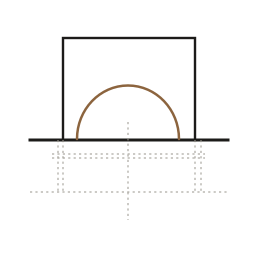
The state of identity, truth, and baseline. Foundation asks what a piece of work is actually built on — not what it says it's built on, but the genuine beliefs, values, and knowing that will hold when the work is tested.

The state most people skip. Conviction examines whether what you're building from is genuinely yours — arrived at through your own experience and discernment — or absorbed from training, industry standards, or environments that rewarded something other than your natural knowing.
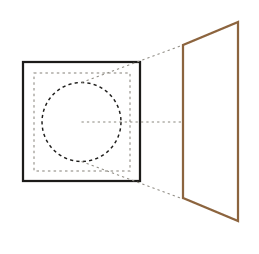
The state where internal architecture becomes external reality. Expression is also where real feedback first becomes possible — while work stays internal, the only feedback available is imagination. Real encounter requires expression.
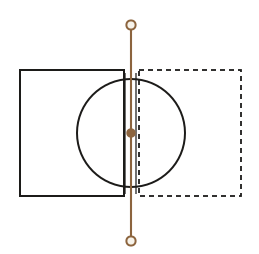
The state where what has been expressed gets made more precisely itself — stripped of what accumulated during Expression that served then but doesn't serve now. Refinement is always guided by actual evidence from actual encounter, never by imagined concerns.
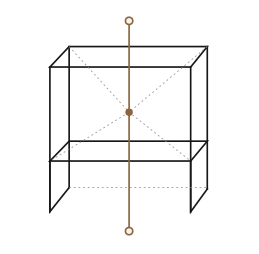
The state where a piece of work has earned the quality of holding without requiring constant personal maintenance. Authority is not claimed — it is earned through enough real-world encounter that the work's reliability is structural rather than aspirational.
- Does this feel solid when I'm delivering it — or hollow?
- When I say this is mine, do I mean it from the inside?
- Have I put this into the world enough to have real feedback from real people?
- Is what I'm refining based on actual evidence from actual delivery — or imagined concerns?
- Does this work hold when I'm not directly present to hold it?
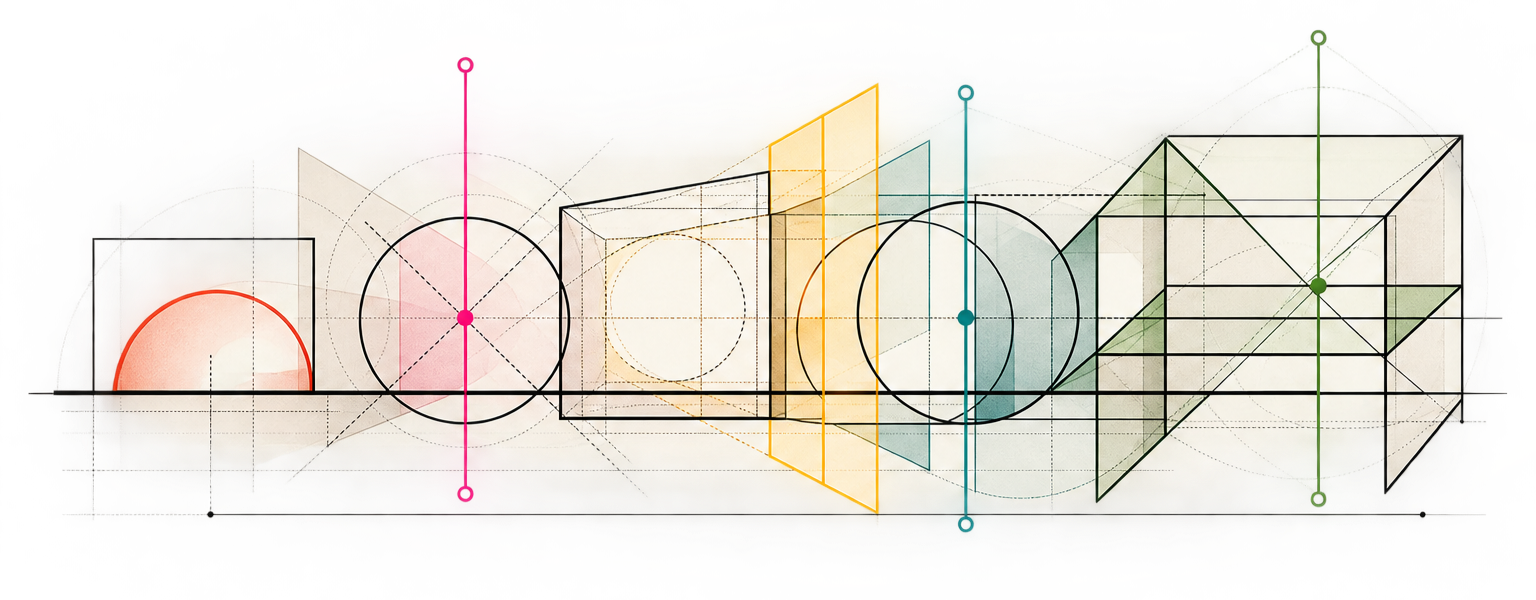
The five operational states describe how something true becomes something that can hold.
Foundation establishes what the work is built from: the identity, values, beliefs, and knowing underneath it. From that ground, Conviction asks whether what you are building is genuinely yours — something you know through experience and discernment — or something you have inherited, absorbed, or learned to perform.
But knowing alone is not enough. Expression moves what is internally known into the world, where an idea, contribution, or way of working takes form and can finally encounter reality. That encounter creates the conditions for Refinement. What worked can be strengthened. What was assumed can be questioned. What no longer serves can be released. The work becomes more precise not through endless self-correction, but through evidence.
Over time, what survives that process begins to develop Authority. It no longer requires constant effort, explanation, or personal maintenance to make it credible. It has been tested enough to hold.
These states are sequential, but they are not separate. Expression reveals what needs refinement. Refinement can expose a weakness in conviction. A challenge to conviction may send you back to foundation. And authority itself continues to be informed by new encounters with reality.
The goal, then, is not to arrive at Authority and remain there. It is to develop an architecture in which all five states can work together: grounded enough to know what is yours, discerning enough to trust it, willing enough to express it, responsive enough to refine it, and tested enough for it to hold.
Top Three Stack

Requires access to the full Origins OS experience. Go here to purchase the program.
Requires access to the full Origins OS experience. Go here to purchase the program.

Requires access to the full Origins OS experience. Go here to purchase the program.
Requires access to the full Origins OS experience. Go here to purchase the program.

Your OCEAN Mapping
Your Next 7 Days
Your Integration Phrase
From Recognition to Discernment
Not another interpretation of your score — a set of questions worth sitting with.
- Where has this pattern remained consistent across different seasons?
- Where has circumstance amplified or suppressed it?
- Where might strength have become overuse?
- What responsibilities are actually yours?
- What needs further discernment rather than immediate action?
- How might these patterns serve people beyond yourself?
Continue with Origins OS
Origins OS is the deeper guided experience for understanding how those patterns operate across your life and work — and learning to work with them more intentionally over time.